7 Herniated Disc Exercises & Stretches For Lower Back
7 Herniated Disc Exercises & Stretches For Lower Back
7 Herniated Disc Exercises & Stretches For Lower Back
It is estimated that up to 80% of individuals will suffer from an episode of low back pain during their lifetime and Lumbar disc herniations are one of the common underlying issues.
In this articles we will dive into specific herniated disc exercises that you can do at home (at the bottom).
Disc herniation most commonly occurs in the lower back (lumbar spine) and involves the displacement of disc material beyond the inter-vertebral disc space.
In the most simple terms, the spine is made up of individual vertebrae stacked on top of each other. Between each vertebrae is an intervertebral disc that provides a cushion so the vertebrae don’t rub together.
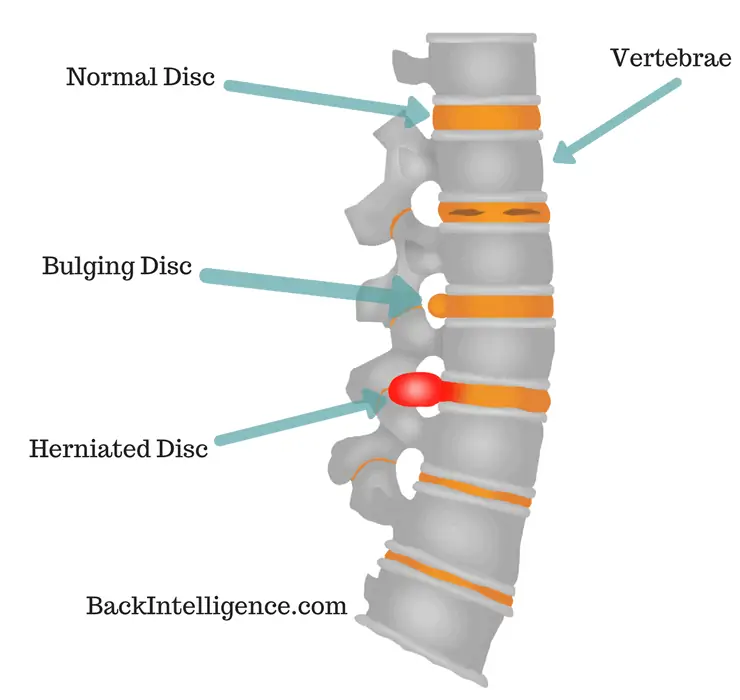
Furthermore, these discs (intervertebral discs) between the vertebrae, have a gel-like material inside (called a nucleus pulposus). A herniated disc is when that gel-like material ruptures through the outer layer of disc, and can press on the spinal cord or spinal nerves, resulting in symptoms, including disabling back pain and other associated symptoms that can make everyday activities difficult to perform.
This illustration may help:
Note: A herniated disc is usually worse than a bulging disc.
Before we get to 7 herniated disc exercises, let’s talk a little about the symptoms and treatment options of lumbar disc herniation…
Symptoms of herniated lumbar disc:
– Lower back pain (typically the first symptom)
– Leg pain (traveling up and down)
– Leg numbness or tingling (traveling pain)
– Leg weakness
– Pain is worse from sitting
– Restricted trunk flexion
– Sciatica pain (Pinched Nerve)
Please note, a herniated disc DOESN’T always cause pain, so you must get a proper diagnosis.
IMPORTANT: An extremely rare symptom of lumbar disc herniation is the loss of bowel or bladder control, which may signal that a more serious problem is lurking – cauda equina syndrome. This syndrome results from compression of the spinal nerve roots and is considered a medical emergency that requires immediate attention.
What does a herniated disc feel like?
Lower back pain is typically the first symptom of a lumbar disc herniation. Often this pain will last for a few days and then subside, but leg pain, numbness or tingling, and/or weakness of the lower extremity often follows.
Typically the leg pain eventually travels below the knee and can even affect the ankle and foot.
How long does the pain last?
Most patients with a lumbar disc herniation will improve gradually over a period of days to weeks, with most patients being symptom free within 3 to 4 months.
Exercise works….
Patients that actively participate in an exercise program often report a significant reduction of pain and improved ability to perform their activities of daily living.
7 Herniated Disc Exercises For Lower BackPlease do them gently!
Treatment Methodology:
1. Spinal Decompression
How it helps – Spinal decompression should be the very first thing you do to treat a herniated or bulging disc because it essentially creates space between your vertebrae, and thus takes pressure off the discs.
How to do it
– Use a bar or the top of a door (or anything you can hang from) and allow your body to “just hang”.
– Hang for 30 seconds and do 3 sets.
– Release very slowly from this so as not to cause any spasms.
** This should not cause any pain. If you feel pain during it is not a good one for you. In that case, stop and try some of the other exercises below instead.
2. Standing Extension
How it helps – This standing extension helps reverse what you do on a daily basis (hunching)… Since most bulging discs and herniated discs are caused by poor posture and repeated flexion of the spine (esp bending fwd in bad posture), this stretch helps push the disc back to neutral position.
How to do it
– Begin this exercise by standing up with good posture. Now take both hands and place them on both sides of your lower back. Now with the help of your hands push your pelvis forward and extend your spine back. Follow the extension with your neck so that you end up facing the ceiling.
– Start with 10 repetitions and do 2-3 sets.
– This one is particularly great to do when you need a break from sitting at your desk.
** This should not cause any pain. If you feel pain during it is not a good one for you. In that case, stop and try some of the other exercises below instead.
3. Half Cobra Pose (Prone Lumbar Extension)
How it helps – The Half Cobra Stretch helps to push the disc material back towards the center of the inter-vertebral disc to allow for improved healing. The goal of repeated lower back extension is the “centralization of symptoms”, which basically means pain that travels down the affected leg to the foot should come back up closer to the low back – which will in turn alleviate the pain.
How to do it
– Begin this exercise by lying on your stomach (prone position) and slowly prop yourself up on your elbows while keeping your hips in contact with the floor.
– Hold the prop-up position for 10-15 seconds before returning to the prone position (lying face down).
– Gradually increase to holding the end position for 30 seconds. Aim for 10 repetitions of this stretch.
** Initially, you may not be able to tolerate this position very well, so make sure you start slowly and carefully. If there’s any pain, try a different exercise instead.
4. Full Cobra Pose (Advanced Extension)
How it helps – This stretch is based on the same principle as the half Cobra pose above. This advanced extension helps to push disc material back towards the center of the intervertebral disc, with the goal of alleviating pain symptoms.
How to do it
– Once you’ve mastered the half cobra pose, you can increase the difficulty by moving to the advanced version of this stretch. Begin this exercise by lying on your stomach in the prone position (lying facing down) and slowly press up on your hands while keeping your pelvis in contact with the floor and lower back relaxed.
– Hold the prop-up position for 10 seconds. Aim for 10 repetitions of this stretch.
– Eventually try to hold this pose for longer if it feels good (20-30 seconds).
** If you feel pain during this exercise, it is not a good one for you. In that case, stop and try some of the other exercises instead.
5. Cat-Cow
How it helps – This is one of the most popular herniated disc exercises. By combining two yoga poses, the cat-cow stretch can help to relieve pressure on the herniated disc by opening the intervertebral disc space. It also improves mobility of the spine, which may help to relieve disc herniation pain and speed recovery.
How to do it
– Begin this stretch on your hands and knees. Inhale and let your stomach “drop” towards the floor as you look up towards the ceiling.
– Follow this by exhaling and slowly rounding your spine while pressing into the floor with your hands and slightly curving your neck to look at your feet.
– Aim for 10 repetitions of this stretch and do 2-3 sets.
6. Bird Dog
This is a great exercise to improve core strength and lumbar back muscles.
How to do it:
– Begin on your hands and knees, with your hands positioned under your shoulders and knees positioned under your hips.
– Brace (contract) your core as hard as you can before beginning any movement.
– While bracing your core, raise your left arm and reach it forwards until it is aligned with your torso; at the same time, kick your right leg backwards until is it aligned with your torso.
– It’s important to not arch your low back as you do this.
– Hold this position for 2-3 seconds before slowly returning to the starting position.
– Repeat with your right arm and left leg.
– Alternate sides for 10 repetitions.
** Only extend your arm and leg to where it’s comfortable and don’t arch your low back.
7. Plank
This exercise is ideal for strengthening both your deep core and gluteal muscles.
How to do it:
Begin lying on your stomach with your forearms against the mat.
– Engage your core and lift your body so that you are resting on your forearms and toes.
– Ensure that your spine is in a neutral spinal position (not sagging in low back, or lifting butt in the air).
– Hold the plank position for 20-30 sec, Then lower down to floor.
– Aim for 2 to 5 repetitions of this exercise.
** Ensure to keep your back straight throughout the entire exercise.
Other herniated disk treatment options include:
Rest – often a couple of days of rest will help to calm severe pain caused by lumbar disc herniation. However, it’s important that you don’t rest for longer than this as it can actually worsen pain and stiffness.
Anti-inflammatory medications – medications such as ibuprofen and naproxen may help to reduce inflammation and relieve pain.
Physical therapy – performing specific exercises to increase range of motion and strengthen muscles in your lower back and core may help to relieve pain and reduce your chance of re-injuring yourself.
Spinal manipulation – manipulation of the joints of the lower back may help to improve range of motion and decrease pain.
Massage therapy – may help to increase blood circulation and relax muscles thereby helping to reduce pain.
Epidural steroid injections – injection of corticosteroids into the affected area may help to reduce local inflammation and relieve pain.

 Call Now


7 Herniated Disc Exercises & Stretches For Lower Back
7 Herniated Disc Exercises & Stretches For Lower Back
It is estimated that up to 80% of individuals will suffer from an episode of low back pain during their lifetime and Lumbar disc herniations are one of the common underlying issues.
In this articles we will dive into specific herniated disc exercises that you can do at home (at the bottom).
In the most simple terms, the spine is made up of individual vertebrae stacked on top of each other. Between each vertebrae is an intervertebral disc that provides a cushion so the vertebrae don’t rub together.
Furthermore, these discs (intervertebral discs) between the vertebrae, have a gel-like material inside (called a nucleus pulposus). A herniated disc is when that gel-like material ruptures through the outer layer of disc, and can press on the spinal cord or spinal nerves, resulting in symptoms, including disabling back pain and other associated symptoms that can make everyday activities difficult to perform.
This illustration may help:
Note: A herniated disc is usually worse than a bulging disc.
Before we get to 7 herniated disc exercises, let’s talk a little about the symptoms and treatment options of lumbar disc herniation…
Symptoms of herniated lumbar disc:
– Lower back pain (typically the first symptom)
– Leg pain (traveling up and down)
– Leg numbness or tingling (traveling pain)
– Leg weakness
– Pain is worse from sitting
– Restricted trunk flexion
– Sciatica pain (Pinched Nerve)
Please note, a herniated disc DOESN’T always cause pain, so you must get a proper diagnosis.
What does a herniated disc feel like?
Lower back pain is typically the first symptom of a lumbar disc herniation. Often this pain will last for a few days and then subside, but leg pain, numbness or tingling, and/or weakness of the lower extremity often follows.
Typically the leg pain eventually travels below the knee and can even affect the ankle and foot.
How long does the pain last?
Most patients with a lumbar disc herniation will improve gradually over a period of days to weeks, with most patients being symptom free within 3 to 4 months.
Exercise works….
Patients that actively participate in an exercise program often report a significant reduction of pain and improved ability to perform their activities of daily living.
7 Herniated Disc Exercises For Lower BackPlease do them gently!
Treatment Methodology:
1. Spinal Decompression
How it helps – Spinal decompression should be the very first thing you do to treat a herniated or bulging disc because it essentially creates space between your vertebrae, and thus takes pressure off the discs.
How to do it
– Use a bar or the top of a door (or anything you can hang from) and allow your body to “just hang”.
– Hang for 30 seconds and do 3 sets.
– Release very slowly from this so as not to cause any spasms.
** This should not cause any pain. If you feel pain during it is not a good one for you. In that case, stop and try some of the other exercises below instead.
2. Standing Extension
How it helps – This standing extension helps reverse what you do on a daily basis (hunching)… Since most bulging discs and herniated discs are caused by poor posture and repeated flexion of the spine (esp bending fwd in bad posture), this stretch helps push the disc back to neutral position.
How to do it
– Begin this exercise by standing up with good posture. Now take both hands and place them on both sides of your lower back. Now with the help of your hands push your pelvis forward and extend your spine back. Follow the extension with your neck so that you end up facing the ceiling.
– Start with 10 repetitions and do 2-3 sets.
– This one is particularly great to do when you need a break from sitting at your desk.
** This should not cause any pain. If you feel pain during it is not a good one for you. In that case, stop and try some of the other exercises below instead.
3. Half Cobra Pose (Prone Lumbar Extension)
How it helps – The Half Cobra Stretch helps to push the disc material back towards the center of the inter-vertebral disc to allow for improved healing. The goal of repeated lower back extension is the “centralization of symptoms”, which basically means pain that travels down the affected leg to the foot should come back up closer to the low back – which will in turn alleviate the pain.
How to do it
– Begin this exercise by lying on your stomach (prone position) and slowly prop yourself up on your elbows while keeping your hips in contact with the floor.
– Hold the prop-up position for 10-15 seconds before returning to the prone position (lying face down).
– Gradually increase to holding the end position for 30 seconds. Aim for 10 repetitions of this stretch.
** Initially, you may not be able to tolerate this position very well, so make sure you start slowly and carefully. If there’s any pain, try a different exercise instead.
4. Full Cobra Pose (Advanced Extension)
How it helps – This stretch is based on the same principle as the half Cobra pose above. This advanced extension helps to push disc material back towards the center of the intervertebral disc, with the goal of alleviating pain symptoms.
How to do it
– Once you’ve mastered the half cobra pose, you can increase the difficulty by moving to the advanced version of this stretch. Begin this exercise by lying on your stomach in the prone position (lying facing down) and slowly press up on your hands while keeping your pelvis in contact with the floor and lower back relaxed.
– Hold the prop-up position for 10 seconds. Aim for 10 repetitions of this stretch.
– Eventually try to hold this pose for longer if it feels good (20-30 seconds).
** If you feel pain during this exercise, it is not a good one for you. In that case, stop and try some of the other exercises instead.
5. Cat-Cow
How it helps – This is one of the most popular herniated disc exercises. By combining two yoga poses, the cat-cow stretch can help to relieve pressure on the herniated disc by opening the intervertebral disc space. It also improves mobility of the spine, which may help to relieve disc herniation pain and speed recovery.
How to do it
– Begin this stretch on your hands and knees. Inhale and let your stomach “drop” towards the floor as you look up towards the ceiling.
– Follow this by exhaling and slowly rounding your spine while pressing into the floor with your hands and slightly curving your neck to look at your feet.
– Aim for 10 repetitions of this stretch and do 2-3 sets.
6. Bird Dog
This is a great exercise to improve core strength and lumbar back muscles.
How to do it:
– Begin on your hands and knees, with your hands positioned under your shoulders and knees positioned under your hips.
– Brace (contract) your core as hard as you can before beginning any movement.
– While bracing your core, raise your left arm and reach it forwards until it is aligned with your torso; at the same time, kick your right leg backwards until is it aligned with your torso.
– It’s important to not arch your low back as you do this.
– Hold this position for 2-3 seconds before slowly returning to the starting position.
– Repeat with your right arm and left leg.
– Alternate sides for 10 repetitions.
** Only extend your arm and leg to where it’s comfortable and don’t arch your low back.
7. Plank
This exercise is ideal for strengthening both your deep core and gluteal muscles.
How to do it:
Begin lying on your stomach with your forearms against the mat.
– Engage your core and lift your body so that you are resting on your forearms and toes.
– Ensure that your spine is in a neutral spinal position (not sagging in low back, or lifting butt in the air).
– Hold the plank position for 20-30 sec, Then lower down to floor.
– Aim for 2 to 5 repetitions of this exercise.
** Ensure to keep your back straight throughout the entire exercise.
Other herniated disk treatment options include:
Rest – often a couple of days of rest will help to calm severe pain caused by lumbar disc herniation. However, it’s important that you don’t rest for longer than this as it can actually worsen pain and stiffness.
Anti-inflammatory medications – medications such as ibuprofen and naproxen may help to reduce inflammation and relieve pain.
Physical therapy – performing specific exercises to increase range of motion and strengthen muscles in your lower back and core may help to relieve pain and reduce your chance of re-injuring yourself.
Spinal manipulation – manipulation of the joints of the lower back may help to improve range of motion and decrease pain.
Massage therapy – may help to increase blood circulation and relax muscles thereby helping to reduce pain.
Epidural steroid injections – injection of corticosteroids into the affected area may help to reduce local inflammation and relieve pain.
If you can’t find it, search